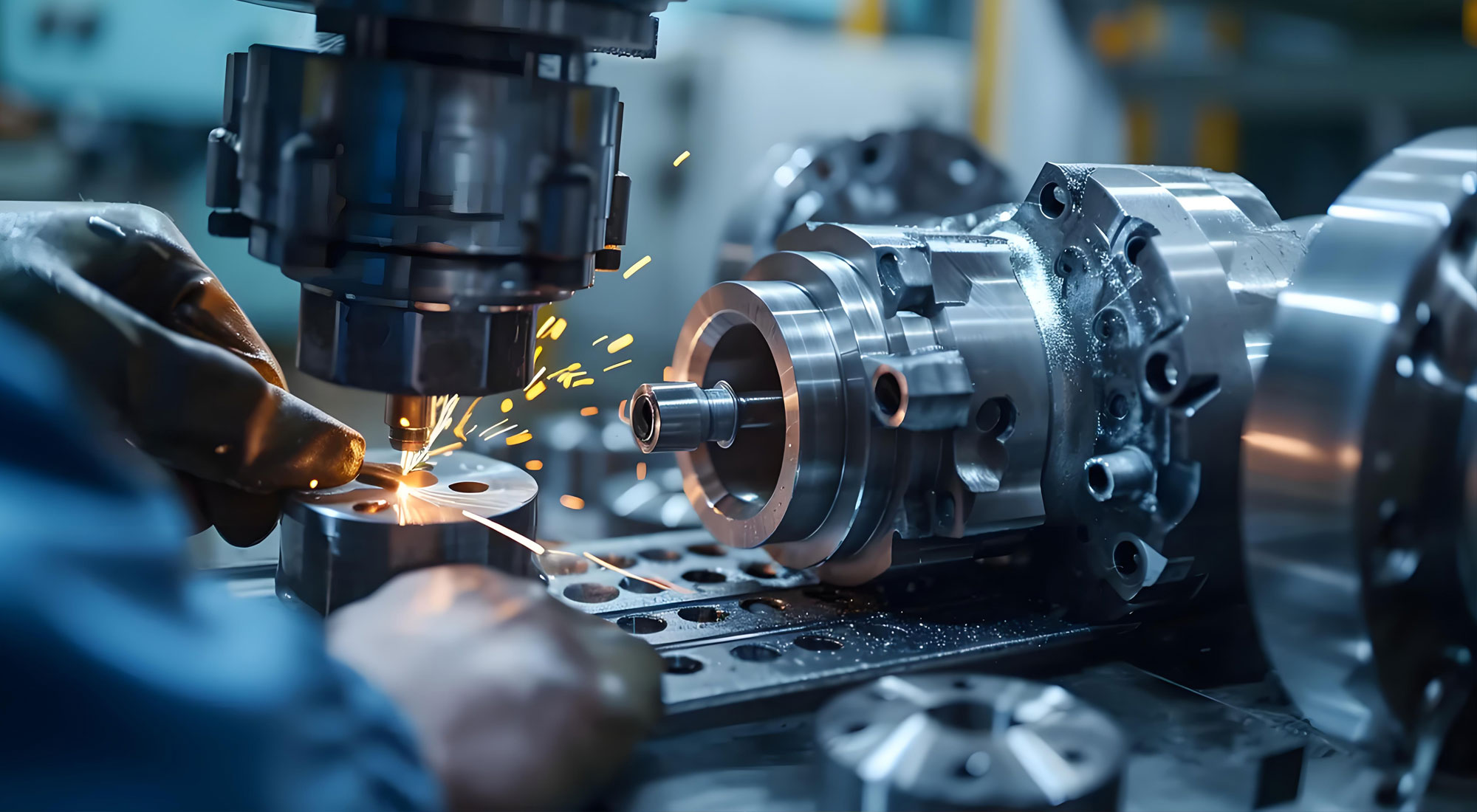
MIM parts are metal components molded from a metal-powder feedstock and then sintered to full density, so complex geometry such as gear teeth, cross-holes and undercuts forms in one cycle instead of several machining setups. Ningbo Precision Tech produces custom MIM parts from 0.1 to 150 g in stainless, low-alloy, titanium, tungsten and soft magnetic alloys.
MIM pays off where a small metal part is complex, runs in volume, and would otherwise be machined feature by feature or assembled from several pieces. Five families cover most of what we ship:
Complexity is nearly free in the mold: a part with four machining setups on a bar stock usually becomes one molding cycle plus one finishing operation. What MIM does not do well is very large parts, thick sections, or single-piece prototypes — those stay with casting or CNC.
| Industry | Typical parts we mold | Where to look |
|---|---|---|
| Automotive & bicycle | Oil-pump gears, brake components, derailleur pawls, positioning ratchets, slider parts | Automotive & bicycle parts |
| Precision machinery | Toggle forks, needle-threading inserts, linear bearing cages, drive gears | Precision machinery parts |
| Medical equipment | Forceps jaws, hemostatic clamp parts, diagnostic device components, aesthetic device parts | Medical device parts |
| Consumer electronics | Smart-lock cylinders, deadbolt mechanisms, bevel gears, slide tongue holders | Consumer electronics parts |
| Aerospace & military | Triggers, locating pins, power-tool gears and pawls, air-gun valve parts | Aerospace & defence parts |
| Outdoor sports | Bow release triggers, arrow inserts and nocks, fishing reel components | Outdoor sports parts |
| Carbide | WC-Co nozzles, threaded carbide connectors, wear inserts | Cemented carbide parts |
Stainless steels (316L, 17-4PH, 420, 440C, 304/SUS304), low-alloy steels (Fe-2Ni, Fe-8Ni, 4140, 4340, case-hardened 8620), tool steels (M2, D2), nickel and cobalt alloys (Inconel 718, Hastelloy X, Co-Cr F75), titanium (CP Ti, Ti-6Al-4V), cemented carbide (WC-Co), tungsten heavy alloys (W-Ni-Fe, W-Ni-Cu), soft magnetic alloys (Fe50Ni, Fe-Si) and copper or Kovar for thermal and electrical parts.
Grade-by-grade tensile data is on MIM material properties; the application matrix is on MIM materials and applications.
| Parameter | Capability |
|---|---|
| Part weight | 0.1–150 g typical; up to 250 g demonstrated |
| As-sintered tolerance | ±0.3% of dimension; ±0.5% on complex net-shape features |
| With secondary machining | ±0.1% on selected features; bores to H7 |
| Minimum wall | 0.3 mm; under 6 mm recommended |
| Sintered density | >97% typical |
| Surface, as-sintered | Ra 0.8–1.6 µm; below Ra 0.4 µm after electropolishing |
| Finishing | Heat treatment, hardening, plating, passivation, tumbling, CNC touch-up, assembly |
| Batch | Prototypes 500–1,000 pcs; production 10,000+ pcs/year |
| Lead time | 5–8 weeks from design release to tooling and samples |
Ready to price a part? Send the drawing — DFM feedback and an indicative piece price come back together.
From 0.1 g micro parts up to 150 g typical; 250 g has been demonstrated. Above roughly 250 g, casting or machining is usually the better route.
Prototypes from 500–1,000 pieces. Production economics turn at 10,000+ pieces per year; below that we still quote and will say if CNC is cheaper.
In most cases yes. 316L, 17-4PH, 420, 440C, low-alloy steels, titanium and soft magnetic alloys are standard for us; send the spec and we confirm the sintered equivalent.
Yes — heat treatment, hardening, plating, passivation, tumbling, CNC touch-up and assembly are handled or managed in one place.
As-sintered ±0.3% is standard, ±0.1% on selected features after machining. First articles come with a dimensional report, and serial parts run under SPC on the critical dimensions.
A 2D drawing with tolerances or a STEP file, the material, surface requirement and annual volume. If you have a target price, include it — it tells us where to focus the DFM work.
 Русский
 Español
 Deutsch
 日本語