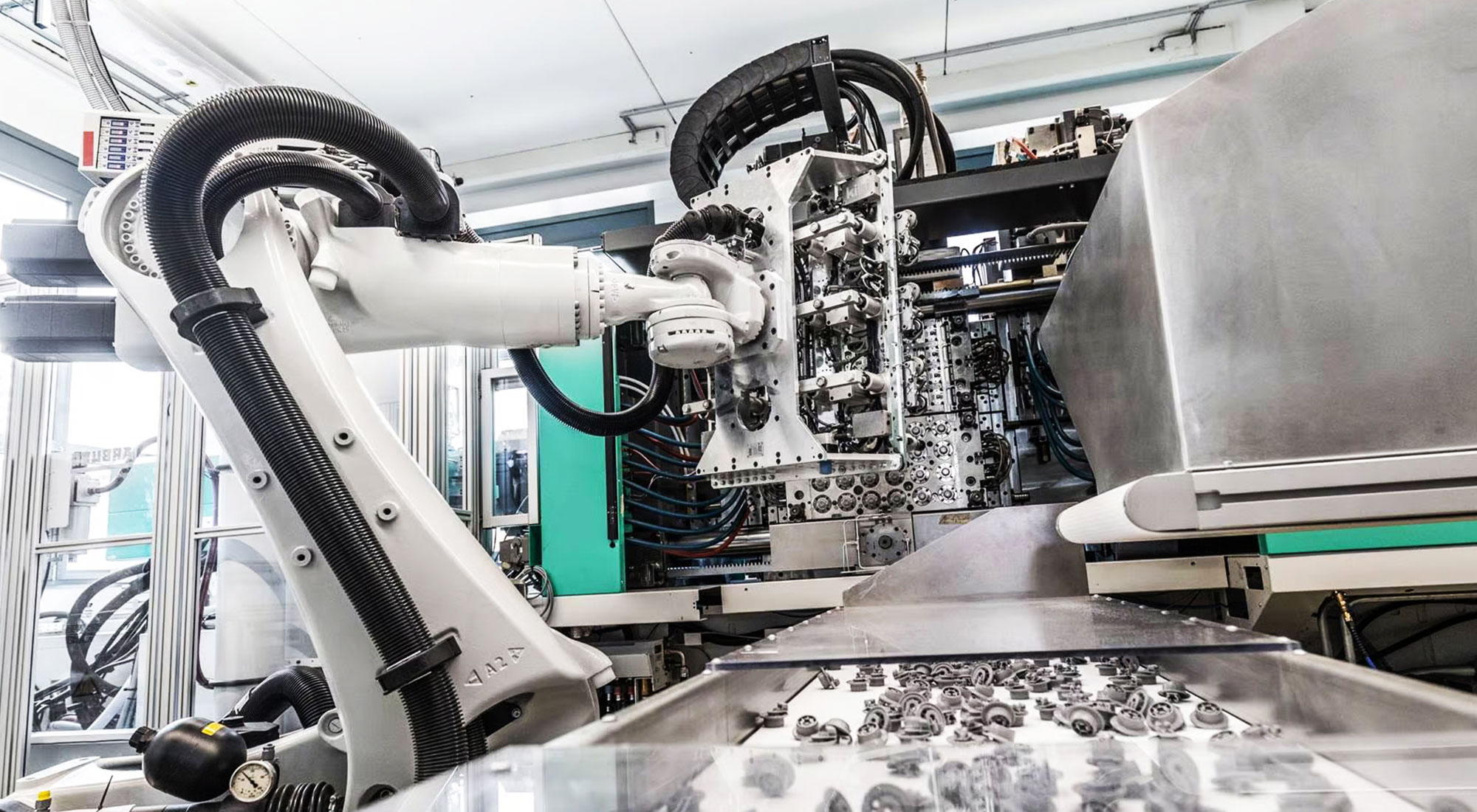
The MIM process has four steps: compounding metal powder with a thermoplastic binder into feedstock, injection molding the feedstock into a steel mold, removing the binder, and sintering at 1,200-1,400 C to above 97% density. Each step controls a different failure mode, which is why all four run under one roof.
After sintering, only the operations the drawing actually needs are added: hardening, CNC touch-up, plating, tumbling or assembly.
| Step | Key variable | What goes wrong if it drifts |
|---|---|---|
| Feedstock | Powder size distribution, binder ratio, mixing time | Uneven shrinkage, cavity-to-cavity variation, weld lines |
| Molding | Injection pressure, melt temperature, mold temperature, gate position | Short shots, voids, internal stress that shows up after sintering |
| Debinding | Temperature ramp, atmosphere, time | Cracking, blistering, residual carbon |
| Sintering | Peak temperature, hold time, atmosphere, cooling rate | Low density, distortion, wrong carbon level, dimensional drift |
| Finishing | Machining allowance, heat-treat cycle, coating thickness | Tolerance stack failures, hardness out of spec |
MIM suits small, complex parts in volume: 0.1-150 g typical, walls from 0.3 mm, as-sintered tolerance ±0.3%, and 10,000+ pieces per year for the economics to work. It runs stainless steels, low-alloy steels, tool steels, titanium, tungsten heavy alloys, cemented carbide, soft magnetic alloys and ceramics.
It is the wrong process for very large parts, thick sections that cannot be sintered evenly, single-digit quantities, or features that need tolerances tighter than ±0.1% without secondary machining. In those cases CNC, investment casting or PM is the better answer, and we say so at quotation.
Process comparison in detail: MIM vs CNC vs casting. Design limits: MIM design guide.
Capacity is 50+ million pieces per year, including 10+ million gears.
Four process decisions set the piece price: cavity count (tooling versus cycle time), part weight, tolerance class (as-sintered versus machined) and finishing steps. A part specified at ±0.3% as-sintered with no secondary machining is often 40-60% cheaper than the same part machined from bar stock at volume.
Send a drawing or STEP file and we return a DFM review with an indicative piece price — contact us.
Feedstock compounding, injection molding, debinding and sintering. Secondary machining, heat treatment and plating follow only where the drawing requires them.
That range is where the powder particles diffusion-bond into a dense solid. Below it, density and strength stay low; above it, grain growth and distortion increase.
The green part is the molded part before debinding, up to 20% larger than final size. The brown part is what remains after debinding, held together by 2-3% residual binder before sintering.
Shrinkage is isotropic and is compensated in the mold design, typically in the range of 15-20% linear for common stainless grades. The exact value is measured on first articles.
In practice, molding and sintering. Molding sets internal stress and weld lines; sintering decides density and dimensional drift. Both are controlled by logged parameters, not by operator judgement.
Often yes. Features that would need separate setups, or a part assembled from three pieces, can come out of one mold. That is usually where the largest cost reduction sits.
 Русский
 Español
 Deutsch
 日本語