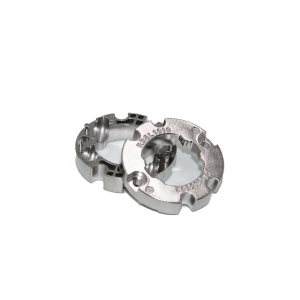
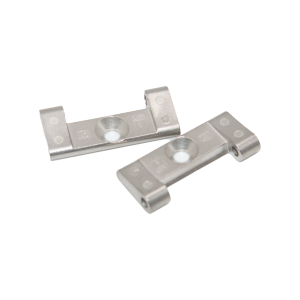
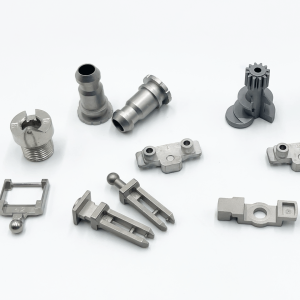
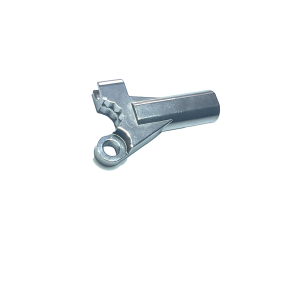
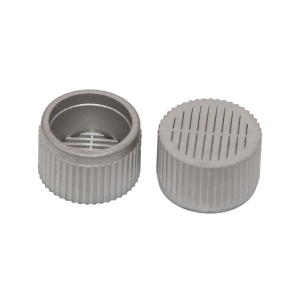
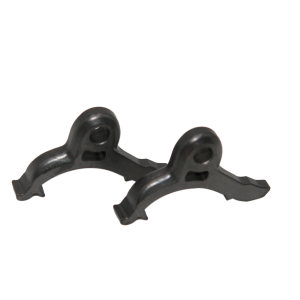
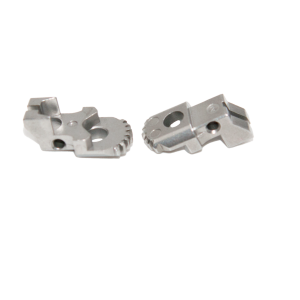
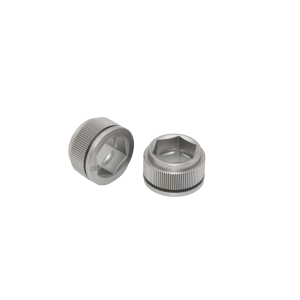
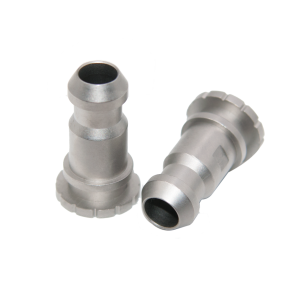
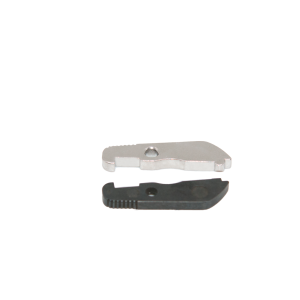
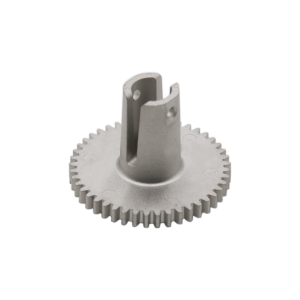
MIM Smart Lock Flip-Tongue Fixing Seat | Precision Lock Mechanism ComponentWhat Is a Flip-Tongue Fixing Seat?The flip-tongue fixing seat is the mechanical actuator behind the main lock tongue in a smart door lock. When the fingerprint sensor, keypad, or mobile app authorizes entry, the motor-driven gear train rotates a cam that pushes against this fixing seat — which in turn drives the main lock tongue to extend or retract. It sounds simple, but the part carries enormous responsibility: it must translate rotational motion into precise linear displacement, withstand thousands of lock/unlock cycles without wear or deformation, and maintain dimensional stability through temperature swings from -20°C winter mornings to 50°C sun-exposed door panels. At Precision-mim, we manufacture flip-tongue fixing seats in stainless steel through the MIM process — achieving the complex cam-following geometry, tight dimensional tolerances, and surface hardness that this safety-critical component demands. |

|
Smart locks occupy a unique position in the hardware world: they combine the physical security requirements of traditional mechanical locks with the miniaturization demands of consumer electronics. The flip-tongue fixing seat exemplifies this challenge:
Traditional manufacturing approaches fail on different fronts:
MIM delivers all four requirements simultaneously: complex geometry, compact design, wear resistance at a material level (HRB 65–75 SS304), and cost-effective production at scale.
| Property | Value (MIM SS304) | Relevance to Smart Locks |
|---|---|---|
| Density | ≥ 7.6 g/cm³ | Full-strength security component |
| Tensile Strength | 480 – 520 MPa | Withstands cam pressure without deformation |
| Hardness | HRB 65 – 75 | Cam-engagement surface resists cyclic wear |
| Elongation | 40 – 50% | Absorbs impact from door slamming without fracture |
| Corrosion Resistance | Passes 48h salt spray (ASTM B117) | Indoor/outdoor door environments |
| Dimensional Tolerance | ±0.3% of nominal | Consistent tongue extension distance |
| Surface Finish (as-sintered) | Ra 0.8 – 1.6 µm | Low-friction cam engagement |
The engagement surface must follow a mathematically defined curve to convert rotary cam motion into linear tongue displacement. MIM molds this profile directly — no form-tool grinding, no multi-axis CNC interpolation. The profile is as repeatable as the tool that produces it, meaning every unit delivers identical lock/unlock stroke distance.
MIM allows the integration of return-spring seats, travel-limit stops, and anti-rattle guides directly into the fixing seat body. These features would require separate components or secondary operations in a machined design.
Zinc die-cast fixing seats exhibit progressive wear (cam surface grooving) that causes increased friction, slower lock response, and eventually motor stall. MIM SS304's through-hardness means the cam surface maintains its profile from cycle 1 to cycle 100,000.
The thin-wall capability of MIM (0.3 mm minimum) allows designers to pack more functionality into the limited depth behind a standard door lock face — critical when integrating motor, gear train, battery, and control board alongside the mechanical lock mechanism.
The engagement surface must follow a mathematically defined curve to convert rotary cam motion into linear tongue displacement. MIM molds this profile directly — no form-tool grinding, no multi-axis CNC interpolation. The profile is as repeatable as the tool that produces it, meaning every unit delivers identical lock/unlock stroke distance.
MIM allows the integration of return-spring seats, travel-limit stops, and anti-rattle guides directly into the fixing seat body. These features would require separate components or secondary operations in a machined design.
Zinc die-cast fixing seats exhibit progressive wear (cam surface grooving) that causes increased friction, slower lock response, and eventually motor stall. MIM SS304's through-hardness means the cam surface maintains its profile from cycle 1 to cycle 100,000.
The thin-wall capability of MIM (0.3 mm minimum) allows designers to pack more functionality into the limited depth behind a standard door lock face — critical when integrating motor, gear train, battery, and control board alongside the mechanical lock mechanism.
| Criterion | MIM SS304 | Zinc Die-Cast | CNC Machined Steel | Stamped Steel |
|---|---|---|---|---|
| Complex cam profile | ★★★★★ | ★★★ | ★★★★ | ★★ |
| Wear resistance | ★★★★★ | ★ (surface wears quickly) | ★★★★ | ★★★ (requires hardening) |
| Integration of features | ★★★★★ | ★★★★ | ★★ | ★ |
| Unit cost @ 10k+ volume | ★★★★★ | ★★★★ | ★★ | ★★★ |
| Corrosion resistance | ★★★★★ (bulk) | ★ (requires plating) | ★★ (requires plating) | ★★ (requires plating) |
| Cycle-life consistency | ★★★★★ | ★★ | ★★★ | ★★★ |
| Parameter | Capability |
|---|---|
| Material | SS304 (AISI 304 / EN 1.4301) |
| Part weight range | 5g – 40g |
| Minimum wall thickness | 0.3 mm |
| Cam surface profile tolerance | ±0.03 mm |
| Dimensional tolerance (as-sintered) | ±0.3% of nominal |
| Hardness | HRB 65 – 75 (as-sintered) |
| Surface finish | Ra 0.8 – 1.6 µm |
| Cycle life (validated) | 100,000+ lock/unlock cycles |
| Surface treatments | Passivation, electropolishing |
| Annual capacity | 50+ million pieces |
Q: Can you match the custom cam profile of our existing lock mechanism design?
A: Yes. We work from your CAD model (STEP, IGES, or native format) and replicate the cam profile through our injection mold tooling. The profile is validated on first-article parts using CMM or optical profilometry to ensure it matches your design intent within tolerance.
Q: How does MIM SS304 compare to sintered powder metal for this application?
A: Conventional press-and-sinter powder metallurgy achieves lower density (typically 85–92%) and poorer surface finish than MIM. The lower density translates to reduced wear resistance at the cam surface. MIM's 96%+ density and smoother as-sintered finish make it the superior choice for the sliding contact surfaces in a smart lock drive train.
Q: What finishes are available for cosmetic surfaces visible through the lock faceplate?
A: As-sintered SS304 has a matte silver-gray appearance. For visible surfaces, we offer electropolishing (bright, reflective finish), PVD coating (chrome, gold, black, gunmetal tones), or bead blasting (satin matte). Note that most fixing seat surfaces are internal and not visible — finish selection typically prioritizes the cam-engagement surface.
Q: Can you produce the mating components (drive cam + fixing seat + lock tongue) as a matched set?
A: Yes, and this is our recommended approach for smart lock manufacturers. Producing all three drive-train components in the same MIM facility ensures matched material properties, consistent surface finishes at sliding interfaces, and system-level validation of the complete mechanical assembly.

 Русский
 Español
 Deutsch
 日本語
日本語