MIM Stainless Steel Appliance Hinges Manufacturer | High-Cycle Door Hinge ComponentsWhy Metal Injection Molding for Door Hinges?Appliance door hinges carry an outsized burden: they determine how a refrigerator, oven, or dishwasherfeelsto the end user. A hinge that wobbles, squeaks, rusts, or sags after a year of use damages the brand perception of an otherwise well-engineered appliance. Traditionally, appliance hinges are made through zinc die-casting or multi-step stamping + machining. Both approaches have proven to be weak links in appliance reliability:
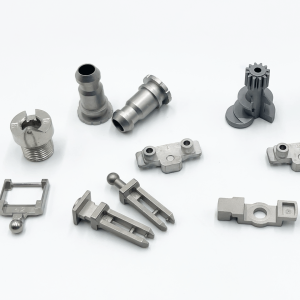
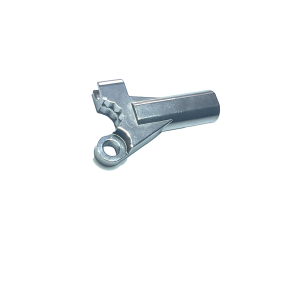
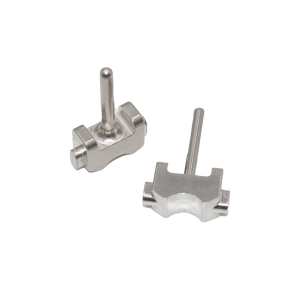
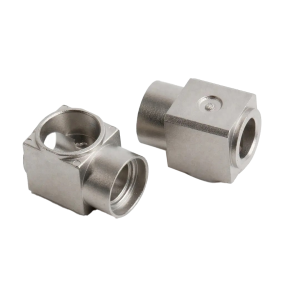
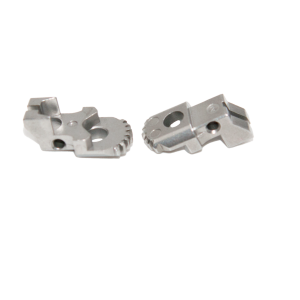
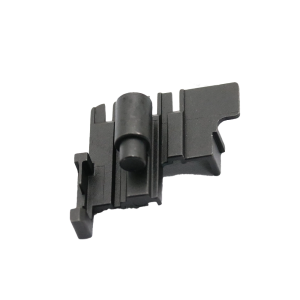
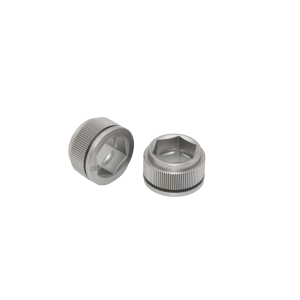
MIM stainless steel hinges solve both problems. The process molds complex 3D geometries in a single step, produces parts with mechanical properties approaching wrought material, and delivers corrosion resistance through the entire cross-section — not just a surface coating that can chip. |

|
A landmark case study published by Ecrimesa (Spain) documented the conversion of a zinc die-cast hinge set to 316L MIM. The results were compelling:
| Performance Metric | Zinc Die-Cast | MIM 316L Stainless Steel |
|---|---|---|
| Tensile Strength | ~280 MPa | 510 – 550 MPa |
| Elongation | 3 – 6% | 40 – 50% |
| Corrosion Resistance | Requires plating | Inherent (bulk material) |
| Creep Resistance at 80°C | Poor (softens) | Excellent |
| Cycle Life Before Failure | ~30,000 cycles | 100,000+ cycles |
| Surface Treatment Needed | Yes (chrome/nickel plate) | None (or optional PVD) |
For an oven door that cycles between room temperature and 250°C hundreds of times over its life, or a refrigerator door that opens and closes 20+ times per day for 15 years — the MIM stainless steel hinge is the engineering choice that prevents warranty claims.
| Grade | Best For | Key Properties |
|---|---|---|
| 316L | Premium appliances, outdoor equipment, marine | Maximum corrosion resistance, non-magnetic, 510+ MPa tensile |
| 304 | Mid-range refrigerators, dishwashers, washing machines | Good corrosion resistance, lower cost, 480+ MPa tensile |
| 17-4PH | Heavy-duty commercial equipment, industrial doors | Heat-treatable to 40+ HRC, 1,100+ MPa after H900 aging |
For most residential appliance applications,304 or 316Lprovides the ideal balance. The non-magnetic property of both grades is a bonus for appliances with magnetic door-seal sensors that must not be interfered with.
Door hinges must support heavy insulated doors (often 15–30 kg when loaded) while enabling smooth, controlled closure. MIM hinges can integrate damping features, alignment pins, and self-lubricating geometry directly into the part design. The stainless steel body resists condensation corrosion in high-humidity cold-to-ambient transition zones.
The most demanding hinge application. Repeated thermal cycling, sustained load at elevated temperature, and exposure to cooking vapors and cleaning chemicals. MIM 304/316L hinges maintain dimensional stability through the full thermal range and do not require protective plating that might off-gas at high temperature.
Constant exposure to hot water, detergent, and rinse aid chemicals. Zinc hinges corrode rapidly; plated steel hinges eventually rust at wear points. Solid stainless steel MIM hinges are chemically immune to the dishwasher interior environment for the life of the appliance.
Vibration fatigue is the primary failure mode. MIM hinges with their high fatigue strength and full-density microstructure outperform sintered powder metal alternatives by a significant margin.
Walk-in cooler doors, commercial oven doors, and dishwasher hood doors see 100+ cycles per day in a 24/7 operating environment. The 100,000+ cycle life of MIM stainless hinges makes them the default choice for commercial-grade equipment.
MIM's design freedom allows features that would require a multi-part assembly in traditional manufacturing:
Our engineering team reviews every hinge design for MIM-optimization opportunities: features that reduce part count in your assembly while improving performance.
| Parameter | Capability |
|---|---|
| Materials | 316L, 304, 17-4PH stainless steel |
| Part weight | 2g – 100g (typical hinge range) |
| Tensile strength (316L) | 510 – 550 MPa |
| Yield strength (316L) | 175 – 210 MPa |
| Elongation (316L) | 40 – 50% |
| Dimensional tolerance | ±0.3% (as-sintered) |
| Surface finish (as-sintered) | Ra 0.8 – 1.6 µm |
| Optional finishes | Electropolishing, PVD coating, passivation |
| Cycle life validation | In-house cycle testing per customer specification |
| Production volume | 50,000 – 5,000,000+ pieces annually |
Q: Are MIM hinges more expensive than zinc die-cast hinges?
A: On a per-piece basis, yes — zinc die-casting has a lower raw material and processing cost. However, when you factor in plating costs for zinc (required for corrosion protection), assembly labor (MIM hinges often consolidate multiple parts into one), and warranty/replacement costs from premature failures, the total cost of ownership favors MIM stainless for any appliance positioned above entry-level pricing.
Q: Can you match the surface appearance of chrome-plated zinc hinges?
A: Yes. As-sintered MIM 316L/304 has a matte silver-gray finish. For a bright, mirror-like appearance, we apply electropolishing (Ra <0.4µm, bright finish) or PVD coating in chrome, gold, black, or rose gold tones. The PVD coating is decorative — unlike plating on zinc, it's enhancing an already corrosion-resistant substrate, not providing the only barrier against rust.
Q: What happens when the hinge reaches its cycle-life limit?
A: Unlike zinc hinges that fail suddenly (fracture or gross deformation), MIM stainless hinges tend to show gradual wear at bearing surfaces — increased play, slight sag — well before functional failure. This graceful degradation provides a safety margin that catastrophic failure modes do not.
Q: Do you provide fatigue and cycle-life test data with production orders?
A: Yes. We perform cycle-life testing according to your specified load, angle, and frequency parameters. A test report is included with PPAP (Production Part Approval Process) documentation for automotive and major appliance customers.
Q: Can you design the hinge from a concept sketch or do you need a finished CAD model?
A: Both. Our engineering team can work from a napkin sketch to develop a production-ready MIM hinge design, or we can take your existing CAD model and DFM-optimize it (Design for Manufacturing) for the MIM process. The earlier we're involved, the more value we can add through part consolidation.
Converting appliance hinges from die-casting to MIM is our specialty. Learn more about the MIM process and see our quality certifications.
Ready to explore MIM for your hinge application? Send us your current design or performance requirements.

 Русский
 Español
 Deutsch
 日本語
日本語