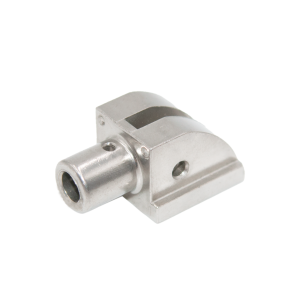
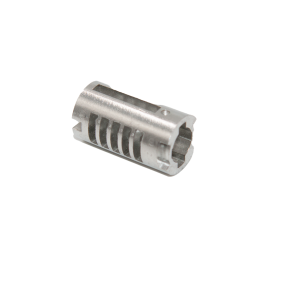
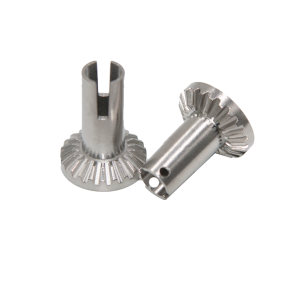
MIM Stainless Steel Bevel Gear | Precision Smart Lock Transmission GearThis MIM stainless steel bevel gear is a small precision transmission component (8–15 mm, module 0.3–0.6) that redirects a smart lock motor's rotation 90° to drive the deadbolt. MIM suits it because the full 3D bevel tooth profile, bore, and hub are molded in one shot, avoiding specialized gear cutting. Key specifications
What Is a Smart Lock Bevel Gear?The bevel gear is the mechanical translator inside a smart lock: it converts the motor's horizontal rotation into the vertical rotation that drives the lock cylinder or deadbolt mechanism. When the fingerprint sensor authenticates, a small DC motor spins — and a pair of bevel gears redirects that motion 90° to throw the bolt. It is a tiny gear — typically 8–15 mm in diameter, module 0.3–0.6 — that carries a disproportionate amount of the smart lock's mechanical responsibility. If the gear teeth wear, the lock develops slop and noise. If a tooth breaks, the lock fails closed — or worse, fails open. And if the gear's bore tolerance is loose, the entire drive train sounds like a coffee grinder. At Precision-mim, we MIM-manufacture bevel gears in stainless steel — capturing the full tooth geometry, bore, and hub features in one shot, with the material strength to handle thousands of lock/unlock cycles without degradation. |

|
Small-module bevel gears are a nightmare to machine conventionally. The tooth profile is three-dimensional — it changes shape from the outer diameter to the inner diameter — which means a standard gear hobbing machine cannot cut it (hobbing produces spur and helical teeth, not bevel teeth). True bevel gear cutting requires a specialized Gleason or Klingelnberg generator — expensive machines that are rare in job shops and impractical for sub-module-1 gears.
MIM sidesteps the entire machining problem:
Cost comparison for a module 0.5, 15-tooth stainless steel bevel gear:
| Material | Hardness | Best For |
|---|---|---|
| SUS304 | HRB 70–85 | General smart lock gearing, low-noise operation |
| 17-4PH H900 | HRC 40–45 | High-torque deadbolt drives, commercial locks |
| 316L | HRB 75–85 | Outdoor/coastal locks, maximum corrosion resistance |
| 440C | HRC 56–60 |
Maximum wear life, high-cycle commercial applications |
| Parameter | Range |
|---|---|
| Module | 0.3 – 1.25 |
| Number of teeth | 10 – 60 |
| Pitch diameter | 5 – 50 mm |
| Tooth form | Straight bevel, spiral bevel, Zerol |
| Pressure angle | 20° standard, custom on request |
| Gear ratio (mating pair) | 1:1 to 6:1 |
| Bore type | Plain, keyed, D-bore, hex, splined |
| AGMA quality class | Q8–Q10 as-molded, Q10–Q12 after burnishing |
Smooth, quiet, reliable — the smart lock experience starts with the gear train. Our ISO-certified MIM process delivers gears that mesh right the first time. See Quality Assurance for documentation.
Need a bevel gear set for your smart lock design? Send your gear specs — module, ratio, torque requirements — and we'll provide a DFM review and quote.
It is the mechanical translator inside a smart lock, converting the motor's horizontal rotation into vertical rotation that drives the lock cylinder or deadbolt. When the fingerprint sensor authenticates, a small DC motor spins and a pair of bevel gears redirects that motion 90° to throw the bolt.
Small-module bevel gears are difficult to machine conventionally because the 3D tooth profile changes from outer to inner diameter, requiring specialized Gleason or Klingelnberg generators. MIM molds the full tooth profile, bore, and hub in one shot, avoiding gear cutting and delivering batch consistency without tool wear variance.
Options include SUS304 (HRB 70–85) for general smart lock gearing and low-noise operation, 17-4PH H900 (HRC 40–45) for high-torque deadbolt drives, 316L (HRB 75–85) for outdoor or coastal locks, and 440C (HRC 56–60) for maximum wear life in high-cycle commercial applications.
We mold module 0.3–1.25, 10–60 teeth, pitch diameter 5–50 mm, in straight, spiral, or Zerol bevel tooth forms with 20° standard pressure angle. AGMA quality is Q8–Q10 as-molded and Q10–Q12 after burnishing, with as-molded bore TIR under 0.03 mm to the tooth pitch circle.
 Русский
 Español
 Deutsch
 日本語