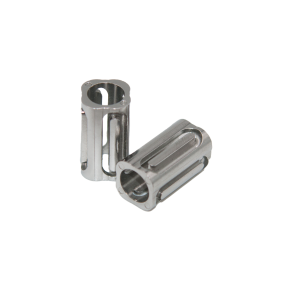
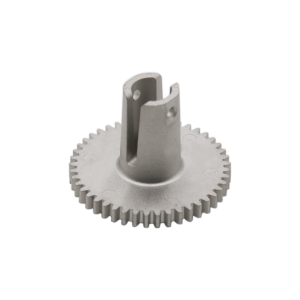
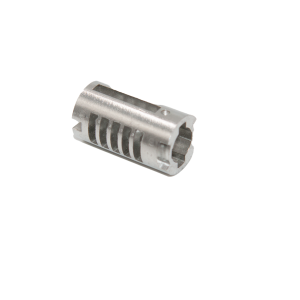
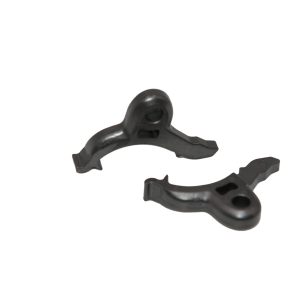
MIM Air Gun Key Parts Manufacturer | Precision Valve, Hammer & Sear ComponentsWhat Are MIM Air Gun Key Parts?Air guns operate with a unique combination of demands: they must seal high-pressure air (2,000–4,500 psi in PCP rifles), transfer that pressure through small internal ports with minimal flow restriction, and cycle mechanical components — hammers, sears, bolts — thousands of times without dimensional drift. The parts at the core of this system are small, complex, and require a combination of properties no single conventional manufacturing method delivers efficiently. Metal Injection Molding (MIM)produces these critical air gun components as net-shape parts — internal bores, angled ports, O-ring grooves, and sear engagement surfaces all molded in a single shot. The material palette (17-4PH, 316L, 4140) covers the full spectrum from high-pressure sealing to high-cycle wear resistance, all from one manufacturing partner. |

|
| Component | Function | Recommended Material | Key MIM Advantage |
|---|---|---|---|
| Valve body | Houses poppet, seals HP air | 17-4PH H900 | Internal bore + O-ring groove in one piece |
| Valve stem / poppet | Opens/closes air path | 17-4PH | Complex head geometry, consistent seal face |
| Hammer | Strikes valve stem to release air | 4140 Q&T / 17-4PH | High density for consistent striking energy |
| Sear / trigger sear | Holds and releases hammer | 17-4PH H900 | Precise engagement geometry, HRC 35-42 |
| Transfer port | Routes air from valve to barrel | 316L / 17-4PH | Smooth internal bore, no machining |
| Bolt / probe | Loads pellet, seals breech | 17-4PH | Complex tip geometry for pellet seating |
| Fill nipple body | Compressed air fill interface | 316L | Corrosion-resistant, precise thread |
| Barrel band | Aligns barrel to air tube | 4140 / 17-4PH | Complex clamping geometry, esthetic finish |
| Magazine rotor | Indexes pellets in multi-shot mags | 17-4PH | Fine-pitch gear teeth in small diameter |
| Breech block / receiver insert | Structural anchor for action | 17-4PH / 4140 | Multi-feature consolidation |
| Property | 17-4PH MIM (H900) | 4140 Steel MIM (Q&T) | 316L Stainless MIM |
|---|---|---|---|
| Density | ≥ 7.6 g/cm³ | ≥ 7.5 g/cm³ | ≥ 7.7 g/cm³ |
| Tensile Strength | ≥ 950 MPa | ≥ 1,000 MPa | ≥ 480 MPa |
| Hardness | HRC 35–42 | HRC 38–45 | HRB 65–75 |
| Corrosion Resistance | ★★★ | ★★ | ★★★★★ |
| High-Pressure Seal Compatibility | ★★★★ | ★★★ | ★★★★★ |
| Magnetic | Yes (slightly) | Yes | No (non-magnetic) |
| Best For | Valves, sears, hammers — the core action | Impact-loaded structural parts | Humid/marine environment air guns |
Why 17-4PH dominates air gun parts:
Precipitation-hardened 17-4PH hits the sweet spot — hard enough for sear engagement surfaces (HRC 35–42 after H900), strong enough for valve bodies holding 3,000+ psi, and corrosion-resistant enough to handle the condensation that builds up inside air tubes after repeated fill cycles. It is the closest thing to a universal air gun component material.
A PCP valve body typically has a central bore, an angled exhaust port, and an O-ring gland — features that require at least three separate machining setups on a Swiss lathe. MIM molds all three in the green part. The as-sintered bore finish (Ra 0.8–1.6µm) is smooth enough for most air passages without secondary polishing.
Hammer mass directly affects muzzle velocity and shot-to-shot consistency. MIM's high density (≥97% theoretical) and tool-based replication mean every hammer in a production run has near-identical mass. No density variation, no energy variation, no velocity spread.
A trigger sear's engagement surface is typically a flat or slightly angled face 2–4mm wide, where a 0.01mm difference in angle or surface condition changes the trigger feel. MIM molds this geometry and holds it across every piece — post-sinter lapping on the engagement face takes seconds per unit.
A conventional PCP valve assembly might consist of: valve body + valve stem + return spring guide + retaining cap = 4 parts. MIM can consolidate the body and cap into one piece, and mold the spring guide feature directly into the valve body — reducing part count, assembly labor, and potential leak paths.
| Parameter | Capability |
|---|---|
| Part weight | 0.2g – 100g |
| Minimum bore diameter | 1.0mm |
| Minimum wall thickness | 0.3mm |
| Internal bore surface finish | Ra 0.8–1.6µm (as-sintered) |
| As-sintered tolerance | ±0.3% of nominal |
| Post-sizing tolerance | ±0.01mm (critical features) |
| Thread capability | External M2–M12, internal M2–M8 (post-machined) |
| Heat treatment | H900 (17-4PH), quench & temper (4140) |
| Surface finish options | As-sintered, bead-blasted, passivated, black oxide, NiB |
| Annual capacity | 30+ million pieces |
| Pressure testing |
Available — helium leak test or hydrostatic proof test |
Q: Can MIM 17-4PH valve bodies reliably hold 3,000+ psi?
A: Yes. At ≥97% theoretical density, MIM 17-4PH has negligible interconnected porosity and functions as a pressure boundary. We verify with 100% helium leak testing or hydrostatic proof testing at 1.5× working pressure on request. For PCP applications up to 4,500 psi, we recommend a safety factor review with our engineering team.
Q: How do you ensure hammer weight consistency?
A: Hammers are weighed on precision balances as part of in-process inspection. For high-end applications, we can hold hammer mass within ±0.5% across a production lot. Mass audit data is provided with each shipment.
Q: Can you produce complete valve assemblies, not just individual components?
A: Yes. We can MIM-produce all metal components (valve body, stem, retaining cap, spring guide) and manage assembly, leak testing, and functional validation. This is an increasingly popular service for air gun OEMs who want a ready-to-install valve module.
Q: What about threads — do you cut them post-sinter or can MIM mold them?
A: MIM can mold external threads (M3 and larger) with acceptable quality for non-critical applications. For sealing threads or threads subject to repeated disassembly, we post-machine them after sintering to ensure full thread form and clean root radius. Internal threads under M6 are typically post-machined.
Q: Can you handle the small feature sizes common in air gun parts?
A: Yes. Transfer ports as small as 1.0mm diameter, O-ring grooves as narrow as 0.5mm, and sear engagement faces as small as 2mm × 3mm are all within our molding capability. Small geometry is where MIM's advantage over machining is greatest.
Q: Do you offer custom alloy development for specialty air gun applications?
A: Our standard grades cover 95%+ of air gun requirements. For highly specialized needs — such as a specific magnetic permeability target or a non-standard hardness range — we can work with our feedstock suppliers to formulate custom blends. Lead time and minimum order quantities apply.
Our MIM process is ISO 9001 certified. Pressure testing and material certification are available on request. Visit Certifications for details.
Designing a new air gun platform or upgrading an existing action? Send us your component specifications for a DFM review and quotation within 48 hours.

 Русский
 Español
 Deutsch
 日本語
日本語