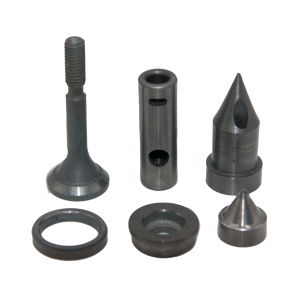
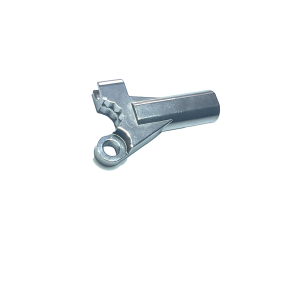
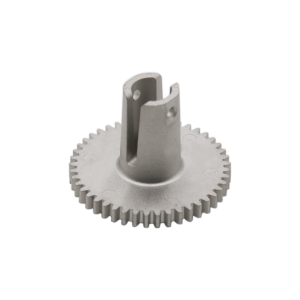
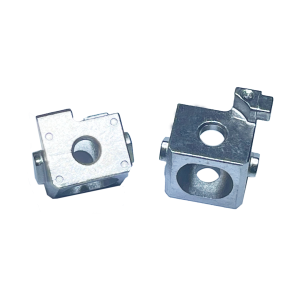
MIM Power Tool Components Manufacturer | Precision Gears, Pawls & Structural PartsWhat Are MIM Power Tool Components?Power tools — drills, impact drivers, angle grinders, circular saws, rotary hammers — operate in brutal conditions. High torque, shock loading, vibration, and dust combine to punish every internal component on every trigger pull. The parts that survive longest are those with the right material, the right heat treatment, and the right geometry from the start. Metal Injection Molding (MIM)is uniquely suited to power tool drivetrain and mechanism components. It produces complex geometries — helical gear teeth, internal splines, asymmetric pawl profiles, thin-walled clutch dogs — in a single net-shape operation. The material options include case-hardening steels (8620, 4140) that achieve surface hardness exceeding HRC 58 while retaining a tough, shock-resistant core — exactly what a hammer drill anvil or impact driver pawl demands. |

|
| Property | 8620 MIM (Case-Hardened) | 4140 MIM (Q&T) | 17-4PH MIM (H900) |
|---|---|---|---|
| Density | ≥ 7.5 g/cm³ | ≥ 7.5 g/cm³ | ≥ 7.6 g/cm³ |
| Surface Hardness | HRC 58–62 | HRC 38–45 | HRC 35–42 |
| Core Hardness | HRC 30–35 | HRC 38–45 | HRC 35–42 |
| Core Toughness | ★★★★★ | ★★★★ | ★★★ |
| Tensile Strength | ≥ 800 MPa (core) | ≥ 1,000 MPa | ≥ 950 MPa |
| Corrosion Resistance | ★ (requires coating) | ★★ (requires coating) | ★★★ |
| Best For | Gears, pawls — high wear surfaces | Shafts, structural parts — high strength | Corrosion-risk tools (marine, plumbing) |
Selection guide:
Cutting a helical gear from bar stock requires a dedicated gear hobbing machine, a skilled operator, and significant cycle time per part. MIM molds the complete gear — teeth, bore, face features — in one shot. Post-sinter sizing or honing on the bore brings it to final tolerance. The result: a gear that costs 50–70% less at volume, with identical AGMA quality class.
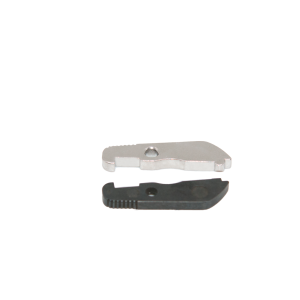
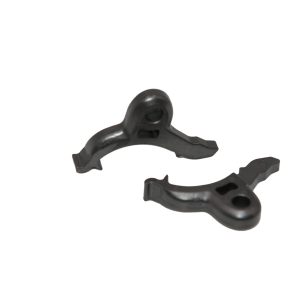
Impact driver pawls have a directional profile — an aggressive drive face and a shallow ramp on the return side. Machining this asymmetry requires a 4-axis setup or a custom form tool. MIM molds it at zero incremental cost, and the molded surface finish (Ra 0.8–1.6µm) reduces friction on the ramp face without secondary polishing.
8620 MIM parts carburize identically to wrought 8620 — the powder metallurgy density of ≥7.5 g/cm³ (≥95% theoretical) leaves negligible interconnected porosity, so the carburizing gas penetrates uniformly. Case depth of 0.3–0.8mm is standard, verified by cross-section microhardness traverse on every batch.
A power tool clutch mechanism might need a separate dog ring, a spacer, and a retaining clip — three parts, three suppliers, three assembly steps. MIM can consolidate all three features into a single component, eliminating assembly labor and tolerance stack-up.
| Component | Tool Type | Material | Key Requirement |
|---|---|---|---|
| Planetary gears | Drill, impact driver | 8620 case-hardened | Tooth flank wear resistance |
| Impact pawls | Impact driver, wrench | 8620 case-hardened | Shock + wear resistance |
| Ratchet gears | Ratchet wrench | 8620 case-hardened | Directional tooth profile |
| Chuck jaws | Drill chuck | 4140 Q&T | Compressive strength |
| Hammer anvil | Rotary hammer | 4140 Q&T | Impact toughness |
| Bevel gears | Angle grinder | 8620 case-hardened | High-speed mesh durability |
| Trigger sears | All tools | 17-4PH | Consistent break, no corrosion |
| Clutch dogs | Hammer drill | 8620 case-hardened | Edge retention under cyclic impact |
| Parameter | Capability |
|---|---|
| Part weight | 0.5g – 200g |
| Gear module | 0.3 – 1.5 |
| Max gear OD | 60mm |
| Tooth profile accuracy | AGMA Class 8–9 (as-sintered), Class 10 (post-honing) |
| Bore tolerance | ±0.01mm (post-sizing) |
| Case depth (8620 carburized) | 0.3–0.8mm |
| Surface hardness | HRC 58–62 (8620), HRC 38–45 (4140) |
| Annual capacity | 50+ million pieces |
| Heat treatment | Carburizing, carbonitriding, quench & temper, H900 |
| Surface finish | As-sintered, shot-blasted, black oxide, zinc-plated |
Q: Can MIM gears handle the same torque as machined gears?
A: In a properly designed gearset, yes. MIM 8620 gears with case-hardened tooth flanks (HRC 58–62) match the bending fatigue and contact stress performance of wrought 8620 gears of equivalent geometry. We provide tooth-root bending stress data with first-article submissions.
Q: What is the typical tooling cost for a power tool gear?
A: Tooling for a single gear cavity typically ranges from $3,000–$8,000 depending on complexity. Multi-cavity tools (4–8 cavities) increase tooling cost but reduce per-part cost significantly — the crossover is typically at 50,000+ annual pieces.
Q: Do you test gears for noise and mesh quality?
A: Yes. We perform double-flank gear rolling tests on every production batch, measuring total composite error (TCE) and tooth-to-tooth composite error (TTCE). Noise-critical applications receive additional single-flank testing.
Q: Can you produce powder metal (PM) parts as an alternative to MIM?
A: We specialize in MIM, which achieves higher density (≥95% vs. 88–92% for conventional press-and-sinter PM) and can produce more complex geometries — including side holes, undercuts, and helical teeth — that PM compaction cannot. If your part is simple and cost is the only driver, we will honestly recommend PM instead.
Q: What is the minimum wall thickness for a gear tooth?
A: We can mold gear teeth with tip width down to 0.3mm. However, for power tool loading conditions, we typically recommend a minimum tip width of 0.5mm for adequate bending fatigue life.
Our MIM process is ISO 9001 certified. Heat treatment and gear inspection are performed in-house. Visit Certifications for details.
Developing a new power tool or upgrading an existing mechanism? Send us your gear or component specifications for a DFM analysis within 48 hours.

 Русский
 Español
 Deutsch
 日本語
日本語