Cemented Carbide MIM Parts Manufacturer | WC-Co Precision ComponentsWhat Is Cemented Carbide?Cemented carbide is a composite material in which micron-sized tungsten carbide (WC) particles are bonded together by a metallic binder — typically cobalt (Co), though nickel (Ni) is used for corrosion-critical applications. The result is a material that combines the extreme hardness of tungsten carbide (comparable to sapphire) with the toughness of a metal matrix. Think of it as "steel on steroids" — and then some. Where tool steel tops out around HRC 65, cemented carbide starts at HRA 85 (roughly equivalent to HRC 70) and goes up from there. It's the reason modern CNC tooling can cut through hardened steel like butter, why mining drill bits survive thousands of meters through solid rock, and why industrial nozzles don't wash out after weeks of abrasive slurry blasting. At Precision-mim, we manufacture cemented carbide components through powder injection molding (PIM/CIM) — achieving the complex geometries that traditional press-and-sinter cannot, while delivering the hardness and wear resistance that only tungsten carbide can provide. |

|
| Grade | Binder | Hardness (HRA) | Density (g/cm³) | TRS (MPa) | Typical Application |
|---|---|---|---|---|---|
| YG6 | 6% Co | 89.5 | 14.9 | 1,800 | Cutting tools, drawing dies |
| YG8 | 8% Co | 89.0 | 14.7 | 2,000 | Impact-resistant wear parts, mining |
| YG10 | 10% Co | 88.5 | 14.5 | 2,200 | Heavy-impact tools, cold heading dies |
| YG15 | 15% Co | 87.0 | 14.0 | 2,500 | Stamping dies, high-impact wear plates |
| YN6 | 6% Ni | 89.5 | 14.9 | 1,800 | Corrosion-resistant applications |
TRS = Transverse Rupture Strength. Higher cobalt = tougher but softer; lower cobalt = harder but more brittle. We help you select the right grade for your specific wear and impact conditions.
Conventional cemented carbide production uses uniaxial die pressing: WC-Co powder is loaded into a steel die cavity and compacted under 1-2 tons/cm² of pressure. This works beautifully for simple prismatic shapes — square inserts, round rods, flat strips. But it has a fundamental limitation: the pressed green body must be ejectable from the die.
This means no undercuts, no cross-holes, no complex internal channels, no threads. Any feature that can't be pressed in two axial directions must be added afterward — by grinding, EDM, or diamond machining. On a material with the machinability of glass.
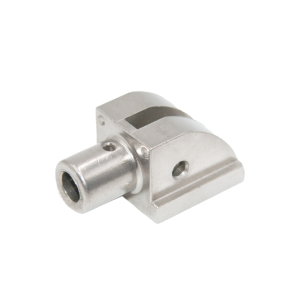
Powder injection molding (PIM) solves this by replacing mechanical compaction with flow-based forming. The WC-Co powder is mixed with a thermoplastic binder system to create a feedstock that flows like plastic — injected into a mold cavity under heat and pressure, then debound and sintered to full density.
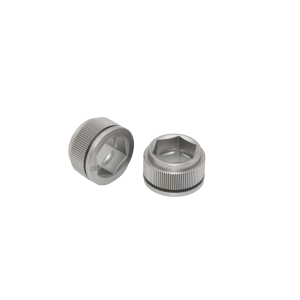
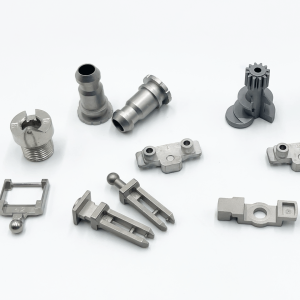
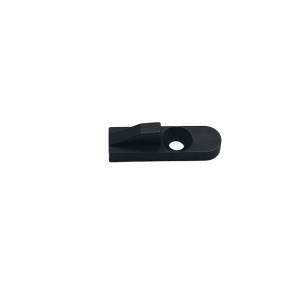
The result: near-net-shape cemented carbide parts with complex 3D geometries, formed in a single molding cycle. Grinding is still needed for critical surfaces, but the stock removal is measured in microns rather than millimeters — and the part geometry is limited by mold design, not by the physics of powder compaction.
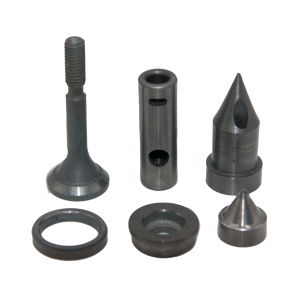
Cross-holes, spiral flutes, internal threads, stepped diameters, and asymmetric profiles — all formed in the mold. Traditional pressing requires green-state CNC machining for any non-prismatic feature, adding cost, lead time, and scrap risk.
As-molded features require only 0.1-0.3 mm of grinding allowance versus 1-3 mm for pressed blanks. This translates directly to lower diamond wheel consumption, shorter grinding cycle times, and fewer scrapped parts from grinding burns.
Die pressing inherently produces density gradients — the powder experiences more compaction near the punch faces than in the mid-plane. Injection-molded carbide achieves substantially uniform green density throughout the part, resulting in more consistent sintered properties and less distortion.
WC-Co powder is expensive (tungsten trades at $300-350 per MTU). Press-to-grind routes often machine away 40-60% of the original blank. Injection molding reduces this to 5-10%, translating to meaningful cost savings on high-volume production.
Indexable inserts, end mills, drill bits, and reamers. Where conventional pressing requires grinding every surface, MIM-formed cutting tools arrive at the grinding station with flutes, chip breakers, and clearance angles already shaped — the grinder only finishes the cutting edge.
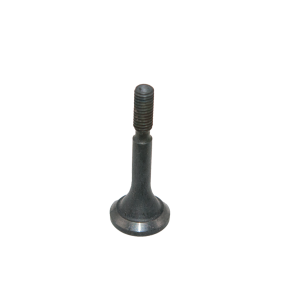
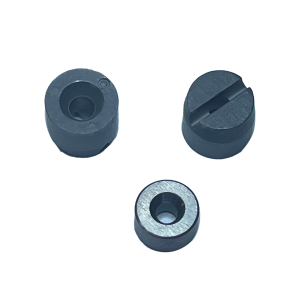
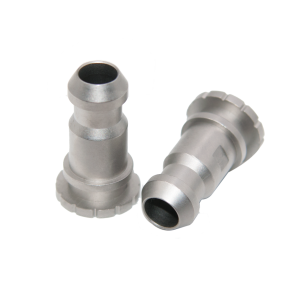
Nozzles, bushings, seal rings, valve seats, and pump components exposed to abrasive slurries, high-velocity particle streams, or metal-to-metal sliding contact. Cemented carbide survives environments that destroy hardened steel in hours.
Drill bit inserts, crusher wear plates, and downhole tooling components. The combination of extreme hardness and adequate toughness (via cobalt content tuning) makes cemented carbide the default material for rock-cutting applications.
Wire drawing dies, heading dies, and extrusion tooling. The polished carbide surface provides low friction and zero galling, while the bulk hardness resists the compressive loads of metal forming.
| Factor | Press & Sinter | MIM/PIM | Advantage |
|---|---|---|---|
| Geometry complexity | 2D prismatic only | Full 3D complexity | MIM |
| Tooling cost | Low ($1-5K per die set) | Moderate ($5-20K per mold) | Press |
| Unit cost (simple shapes) | Very low | Moderate | Press |
| Unit cost (complex shapes) | Very high (grinding dominates) | Low | MIM |
| Density uniformity | Gradient-prone | Uniform | MIM |
| Minimum wall thickness | ~2.0 mm | ~0.5 mm | MIM |
| Surface finish (as-formed) | Ra 0.8-1.2 µm | Ra 0.8-1.5 µm | Comparable |
| Material utilization | 40-60% | 90-95% | MIM |
Q: Can MIM cemented carbide achieve the same density as pressed carbide?
A: Yes. With optimized feedstock formulation (powder loading typically 55-60 vol%) and controlled sintering cycles, MIM cemented carbide reaches 98-99.5% of theoretical density — equivalent to pressed-and-sintered grades. HIP (hot isostatic pressing) post-treatment can close residual porosity to achieve full density when required.
Q: What about grain size control?
A: We work with submicron to medium-grain WC powders (0.5-3.0 µm) depending on the application. Finer grain = higher hardness at the same cobalt content. The injection molding process does not affect grain growth any more than conventional pressing — final grain size is determined by sintering temperature, time, and grain growth inhibitors (VC, Cr₃C₂).
Q: Is there a minimum order quantity?
A: Tooling amortization is the dominant cost driver. For simple geometries with existing press tooling, conventional pressing wins up to very high volumes. For complex geometries where MIM eliminates multiple grinding steps, MIM becomes cost-competitive at 5,000-10,000 pieces per year and increasingly favorable above that.
Q: Can you do cobalt-free grades?
A: Yes. We offer nickel-bonded grades (e.g., YN6, YN8) for applications requiring corrosion resistance — food processing equipment, chemical handling valves, marine components. Nickel provides comparable mechanical properties to cobalt while eliminating cobalt's sensitivity to acidic environments.
Have a cemented carbide component in mind? Send us your drawing or specification — we'll evaluate manufacturability and provide a cost comparison.
 Русский
 Español
 Deutsch
 日本語
日本語