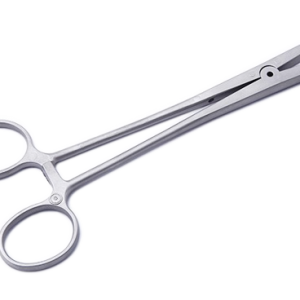
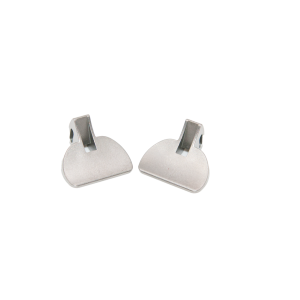
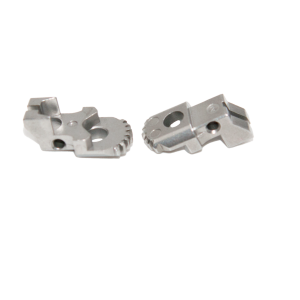
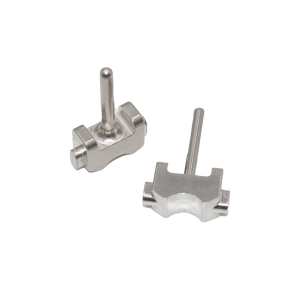
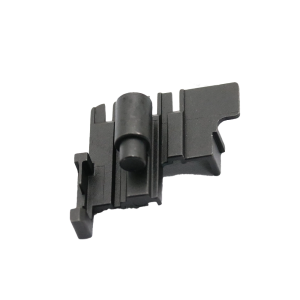
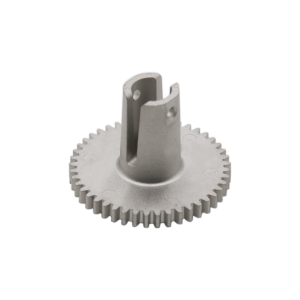
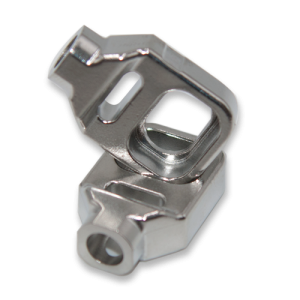
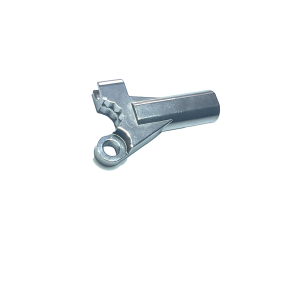
MIM Surgical Forceps Head | Precision Stainless Steel Forceps Jaw ComponentsWhat Is a Surgical Forceps Head?The forceps head — the working end of surgical forceps, needle holders, and tissue graspers — is where instrument design meets surgical reality. The jaw serrations must grip tissue without slipping. The tooth profile must interlock precisely for hemostatic clamping. The tip must be fine enough for microvascular work, yet strong enough not to deform under the clamping force of a surgeon's hand. Traditional forceps jaw manufacturing is labor-intensive: forge or cast a blank, machine the hinge slot, cut the serration pattern (often by hand with a file), heat-treat, polish, and assemble. A single pair of high-quality forceps may involve 30+ manual operations. MIM collapses the most complex step — the jaw serration pattern — into the molding process.The full three-dimensional grip surface, including cross-serration diamond patterns, longitudinal grooves, and atraumatic tooth profiles, is formed in the green state and preserved through sintering. No hand filing. No CNC engraving. Every jaw in the batch is identical. |

|
The surgical instrument industry faces two converging pressures: cost reduction and quality consistency.
| Requirement | Traditional (Forged + Hand-Finished) | MIM |
|---|---|---|
| Jaw serration pattern | Hand-cut, variable | Molded, identical batch-wide |
| Tooth profile consistency | Operator-dependent | Molded, ±0.02 mm |
| Hinge slot precision | Machined, secondary op | Molded, as-sintered |
| Surface finish for cleaning | Multi-step polishing | Ra 0.8 μm as-sintered + electropolish |
| Production throughput | 20–50/day per craftsperson | 5,000+/day per mold |
| Cost at 10,000 pcs | High (labor-intensive) | 40–60% lower |
| Jaw Type | Application | Molded Features |
|---|---|---|
| Hemostatic (Halsted, Kelly, Crile) | Vessel clamping | Cross-serration, longitudinal groove, box lock slot |
| Tissue forceps (Adson, DeBakey) | Atraumatic tissue handling | Fine 1×2 or 2×3 tooth pattern, smooth grip surface |
| Needle holder (Mayo-Hegar, Castroviejo) | Suture needle gripping | Tungsten carbide insert pockets, cross-hatch grip |
| Dressing forceps | Dressing/gauze handling | Serrated tips, spring-tension hinge |
| Micro forceps | Microvascular, ophthalmic |
0.1–0.3 mm tip geometry, ultra-fine serration |
| Material | Grade | Best For | Autoclavable |
|---|---|---|---|
| 316L stainless | ASTM F138 | General surgical forceps, tissue graspers | Yes |
| 17-4PH | ASTM A564 | Needle holders, high-clamp-force instruments | Yes |
| 420 stainless | ASTM F899 | Cutting instruments, scissors blades | Yes (hardenable) |
| 440C | ASTM F899 | TC insert pockets, wear surfaces | Yes |
| Property | 316L | 17-4PH H900 |
|---|---|---|
| Tensile Strength | 520 MPa | 1,310 MPa |
| Yield Strength | 210 MPa | 1,170 MPa |
| Hardness | HRB 75–85 | HRC 40–45 |
| Density | ≥7.85 g/cm³ | ≥7.65 g/cm³ |
| Elongation | 45% | 10% |
Surgical precision starts with the instrument — and the instrument starts with the jaw. Our ISO-certified MIM process delivers forceps components that surgeons can trust. See Quality Assurance for certifications.
Designing a new surgical forceps line? Send your jaw specifications — we'll provide DFM optimization and a production timeline.

 Русский
 Español
 Deutsch
 日本語
日本語