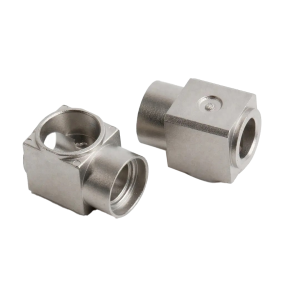
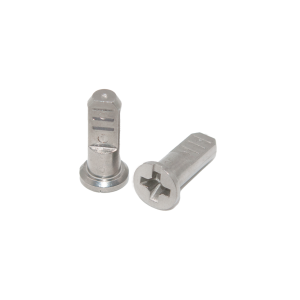
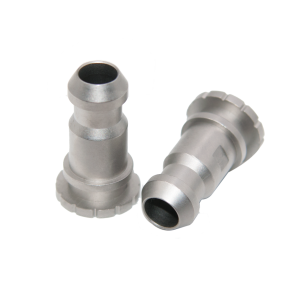
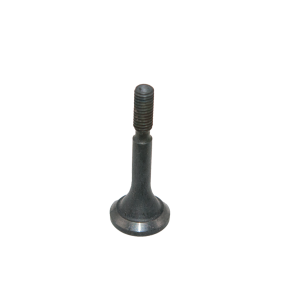
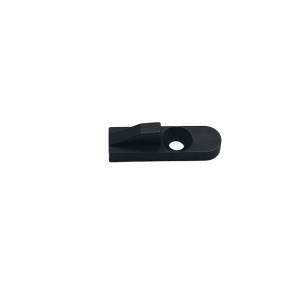
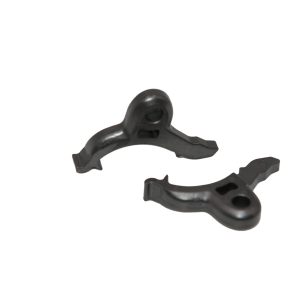
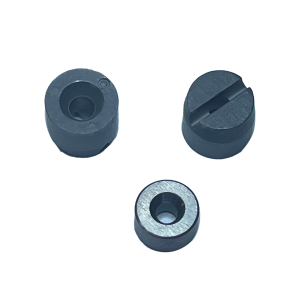
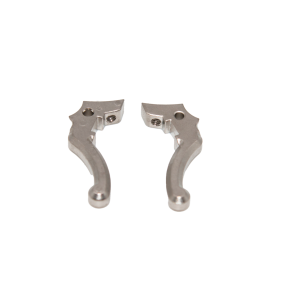
MIM Stainless Steel Glass Door Corner Brackets | Narrow-Frame Sliding Door Spindle ConnectorsWhat Are MIM Glass Door Corner Brackets?In a narrow-frame glass sliding door system, four corner brackets connect the glass panel to the surrounding aluminum frame — one at each corner. These small parts carry the entire weight of the glass panel and transfer motion stress from the sliding mechanism through the frame. When the door slides open and closed thousands of times per year, the corner brackets are the single point of structural dependency. For the Japanese market — where narrow-frame aluminum doors dominate residential and commercial construction — the requirements are exacting: ±0.2 mm dimensional consistency for seamless frame alignment, surface finish that meets Japanese aesthetic standards, and corrosion resistance that survives humid summers without discoloration. |

|
Traditional manufacturing routes fall short:
MIM stainless steel corner bracketsdeliver the precision of machining, the complex geometry of die-casting, and the full-body corrosion resistance of stainless steel — at a per-unit cost competitive with zinc die-casting above 5,000 units. For a Japanese door manufacturer producing 100,000 narrow-frame doors per year, the math is straightforward.
Precision-mim produces custom MIM corner brackets in 304 and 316L stainless steel, with specific experience supplying the Japanese architectural hardware market.
Japan's narrow-frame door market is the most demanding in the world for architectural hardware. Three factors make MIM the preferred manufacturing method:
Dimensional consistency.Japanese assembly lines use automated frame insertion. A bracket that is 0.3 mm oversized jams the machine. One that is 0.3 mm undersized leaves a visible gap between glass and aluminum. MIM's ±0.3% dimensional tolerance (±0.15 mm on a 50 mm part) ensures every bracket fits first time.
Surface finish expectations.Japanese consumers inspect the corner joint of a glass door the way Europeans inspect a kitchen countertop. Visible hardware must have uniform, blemish-free surfaces. MIM's 96%+ density eliminates the micro-porosity that creates cosmetic defects in die-cast or sintered-powder parts.
Humidity resistance.Japan's June–July rainy season (tsuyu) creates constant 80%+ humidity in un-air-conditioned spaces. Zinc brackets with chrome plating fail within 2–3 years as moisture penetrates micro-scratches in the coating. 304 stainless steel MIM brackets have no coating to fail — the entire cross-section is corrosion-resistant.
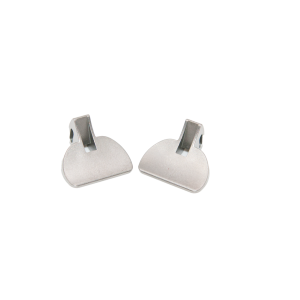
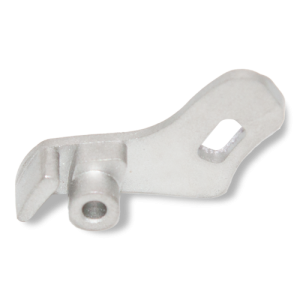
A complete glass door requires two types of corner brackets — top brackets (connecting glass to the upper aluminum rail, often with integrated roller mounting) and bottom brackets (connecting glass to the lower rail, handling the majority of the weight). MIM allows both designs to be produced from the same material with the same process, ensuring visual consistency across all four corners. Screw bosses, alignment ribs, and clamping channels are molded in — zero secondary assembly.
With tensile strength of 480–520 MPa (304 grade), a pair of MIM corner brackets safely supports a standard 8 mm tempered glass panel weighing up to 25–30 kg. The safety factor of 3× or higher means the brackets handle not just static weight but also the dynamic forces of sliding — acceleration, deceleration, and the occasional door slam.
The corner bracket must seat precisely into the aluminum frame channel. MIM produces the tight-tolerance external profile required for this interface without post-machining. The bracket's stainless steel surface is galvanically compatible with anodized aluminum — unlike zinc, which forms a galvanic couple and corrodes at the interface over time.
As-sintered MIM surfaces can be mechanically polished to a mirror finish (Ra ≤0.2 µm) or brushed for a satin look — matching the aesthetic standards of premium Japanese door brands like LIXIL, YKK AP, and TOSTEM. PVD coating in black, gold, or champagne further expands the design palette.
Once the MIM mold is qualified, every bracket in a 100,000-unit production run is dimensionally identical. For Japanese manufacturers who value consistency above all else, this is the defining advantage over multi-process alternatives where variability accumulates across stamping, machining, and plating steps.
The primary application. Used at all four corners of tempered glass panels (4–12 mm thickness) mounted in aluminum frames. Doors range from closet partitions to full-room dividers in residential and hotel construction.
Corner brackets for frameless shower doors face the combined challenge of water exposure, soap chemicals, and glass weight. 316L MIM brackets provide chloride-grade corrosion resistance without the bulk or cost of machined alternatives.
Floor-to-ceiling glass partitions in modern offices use corner brackets at every glass-to-frame junction. The brackets are fully visible — surface finish quality directly impacts the perceived value of the installation.
High-end retail display cases for luxury goods require corner connectors that are as thin as possible while supporting heavy glass shelves. MIM allows wall thicknesses down to 1.0 mm in non-load-bearing areas, minimizing the visible hardware footprint.
| Parameter | Capability |
|---|---|
| Material | Stainless Steel 304, 316L |
| Density | ≥7.6 g/cm³ (≥96% theoretical) |
| Tensile Strength | 480–520 MPa (304), 510–550 MPa (316L) |
| Yield Strength | ≥175 MPa (304), ≥205 MPa (316L) |
| Elongation | ≥35% |
| Surface Finish | Mirror polish (Ra ≤0.2 µm), brushed/satin, PVD (black/gold/champagne) |
| Dimensional Tolerance | ±0.3% (typical ±0.15 mm on 50 mm part) |
| Max Part Dimensions | 80 × 80 × 40 mm |
| Min Wall Thickness | 1.0 mm |
| Thread Capability | M3–M8 internal, moldable |
| Glass Thickness Compatible | 4–12 mm tempered glass |
Q: What glass thickness can your corner brackets support?
A: Our standard designs accommodate 4–12 mm tempered glass. The bracket's clamping channel width is specified per order. We provide load test reports for production runs — typically showing a 3× safety factor for the specified glass weight.
Q: Do you have experience supplying the Japanese market?
A: Yes. We understand Japanese architectural hardware requirements — tight tolerances for automated assembly, surface finish expectations, and packaging standards to prevent cosmetic damage during shipping.
Q: Can the brackets be color-matched to the aluminum frame?
A: Yes. PVD coating in black, gold, champagne, and gunmetal matches common aluminum anodizing colors. Natural polished stainless also pairs well with silver anodized frames — the most common combination in Japanese narrow-frame doors.
Q: Do the top and bottom brackets use the same design?
A: Usually not. Top brackets often integrate a roller or guide channel; bottom brackets prioritize load-bearing. We can manufacture both types within the same mold family for visual consistency.
Q: What's the MOQ for a custom corner bracket design?
A: Typical MOQ is 3,000–5,000 units per design due to upfront mold cost. For annual volumes exceeding 50,000 units, we recommend multi-cavity tooling for lower per-unit cost.
Q: How do MIM brackets compare to zinc die-cast in high-humidity environments?
A: Zinc die-cast relies on surface plating for corrosion protection. In Japan's rainy season (80%+ humidity, 3–4 weeks continuous), zinc brackets with scratched plating begin corroding. MIM 304 stainless has no coating to fail — it's corrosion-resistant through the full cross-section. The extra cost per bracket is recovered in warranty savings.
Explore our MIM process for complex stainless steel hardware and see our quality certifications.
Need a custom spindle or corner bracket design? Send us your drawing or specification for a quick feasibility review.

 Русский
 Español
 Deutsch
 日本語
日本語